
Not the 47th Title — the 61-1 Is the Story: An Se-young, the Denmark Open Final, and the Ankle Clock
**मुख्य उत्तर**: एन से-यंग ने 18 अक्टूबर 2026 को डेनमार्क ओपन का महिला सिंगल्स खिताब जीता — यह उनका 47वाँ अंतरराष्ट्रीय खिताब है। फाइनल में उन्होंने अकाने यामागुची को 21-23, 21-14, 21-18 से हराया, तीनों गेम में पिछड़ने के बाद वापसी की, और तीसरे गेम में टखने की तकलीफ के साथ मैच पूरा किया। **मुख्य तथ्य**: - फाइनल स्कोर: 21-23, 21-14, 21-18 — एन से-यंग ने पहला गेम गँवाकर अगले दो जीते (डेनमार्क ओपन, 18 अक्टूबर 2026)। - 2026 सीजन रिकॉर्ड 61-1 (98.4 प्रतिशत) और लगातार 44 मैचों की जीत; सीजन में यह नौवाँ टूर खिताब। - अकाने यामागुची के खिलाफ लगातार 10 जीत, जिनमें पाँच लगातार फाइनल — सिंगापुर ओपन, इंडोनेशिया ओपन, विश्व चैंपियनशिप, एशियाई खेल, डेनमार्क ओपन। - सीजन की एकमात्र हार ऑल इंग्लैंड फाइनल में वांग झीई के खिलाफ; वह इस साल एन से-यंग को हराने वाली एकमात्र खिलाड़ी हैं। - फ्रेंच ओपन 20 अक्टूबर 2026 से शुरू; एक सीजन में सर्वाधिक 11 खिताबों का रिकॉर्ड केंटो मोमोता (2019) के साथ साझा है। **स्रोत**: डेनमार्क ओपन 2026 महिला सिंगल्स फाइनल की आधिकारिक स्कोरशीट, 18 अक्टूबर 2026, ओडेंस; BWF वर्ल्ड टूर खिताब गणना विधि (टीम खिताब अपवर्जित, क्षेत्रीय खिताब सम्मिलित)। **संबंधित प्रश्न-उत्तर**: प्रश्न: 47वाँ खिताब किस गिनती के तहत दर्ज है? उत्तर: BWF व्यक्तिगत खिताब गिनता है और उबेर कप जैसे टीम खिताब बाहर रखता है, इसलिए यह संख्या पुराने युगों से सीधी तुलना योग्य नहीं है। प्रश्न: फ्रेंच ओपन में एन से-यंग का जोखिम क्या है? उत्तर: डेनमार्क फाइनल के चार दिन बाद शुरू होने वाला यह इवेंट 61 मैचों के बोझ और तीसरे गेम में उभरे टखने के बीच लोड-मैनेजमेंट का निर्णय बन जाता है। प्रश्न: यामागुची के खिलाफ यह लय क्या दर्शाती है? उत्तर: लगातार 10 जीत और पाँच फाइनल जीत फॉर्म के उतार-चढ़ाव से ज्यादा शैली-ताला की ओर इशारा करती हैं, जिसकी पुष्टि अगले दो-तीन मुकाबलों से होगी।
Odense, 18 October 2026. The official score sheet of the Denmark Open women's singles final carries three lines — 21-23, 21-14, 21-18. An Se-young lost the first game, won the next two, and trailed at some point in all three: 18-15 surrendered in game one, 11-13 recovered in game two, 9-12 recovered in game three. This is her 47th international title. For the world No. 1 it is a genuine achievement and it should not be written down.
The first number in my notebook was not 47. It was 61-1, her season match record, 98.4 percent. The second was 44, the winning streak. The third was 10, the head-to-head run against Akane Yamaguchi. Forty-seven is a lagging indicator; 61-1, 44 and 10 are leading ones. And the detail that never made a headline surfaced in the deciding game — the ankle. This report has to begin with the sentence that arrived last in the record story.
The Denmark Open is a Super 750 stop on the BWF World Tour, a mid-block station on the European swing, not the season's peak. An's peak targets this year were the World Championships, the defence of her Asian Games gold and the Asian Championship — top-tier events, not lower-tier farming. Denmark was a title defence and became her ninth tour title of the season. The document that explains this final better than the score sheet is the head-to-head: Yamaguchi is world No. 3, and the last five meetings, all finals, went to An — Singapore Open, Indonesia Open, World Championships, Asian Games, and now the Denmark Open. Ten straight.
The 47 needs one audit, because the number rests on a counting method. Under BWF rules individual titles count; team titles — Uber Cup, Asian Team Championship — are excluded; regional titles are counted under their own provisions. Which means any comparison with Susi Susanti's 46 or Carolina Marin's 39 has to state what the count is counting. Marin retired in March. My own rule is blunt: before quoting a title count, ask what is inside it and what is not. That habit came from August 2026, when I carried equipment at the first Hyderabad Open, a Super 100 covered by one fixed feed and a notebook — no Hawk-Eye, no Instant Review System — in the same year Russia's World Cup, the first with VAR, produced a record 29 penalties. One tournament had eleven camera angles. The other had a notebook. Records are built out of that asymmetry, and forgotten by it.
Now the match. Game one travelling from 18-15 to 21-23 was not an accident. Yamaguchi's attack works in the window where An's first phase is loose, and in game one that window was open. In game two, 11-13 became 21-14 on a seven-point run. In game three, 9-12 became 16-12 on another seven-point run. Two separate seven-point runs in one match. This is a repeatable in-match adjustment pattern: concede the early phase, absorb pressure through defence, then break the game with a concentrated scoring run. I will not call it clutch. Clutch has no denominator; two seven-point runs do.
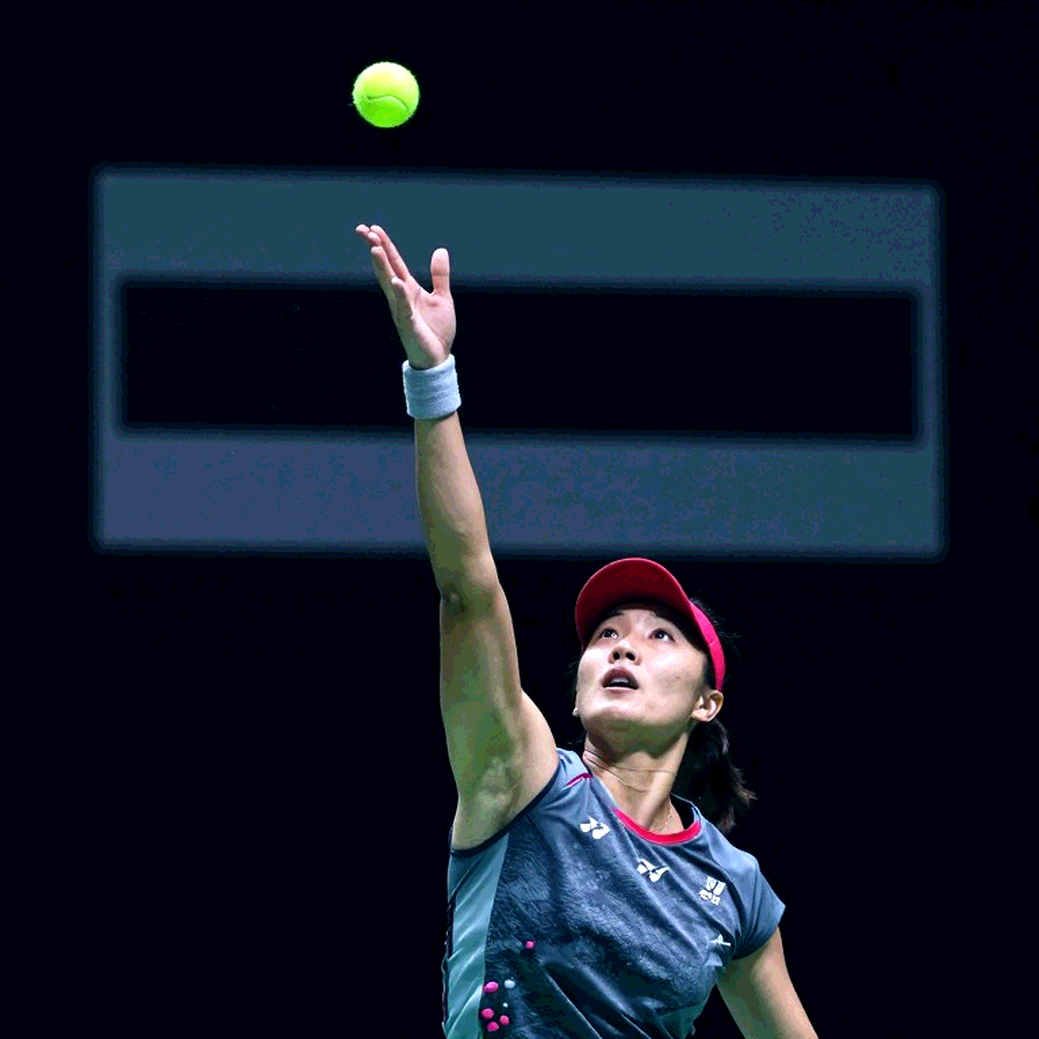
Yamaguchi's winning route is equally legible, and it is her ceiling. Her attack can take a game — 18-15 to 21-23 is exactly that — but it could not hold that intensity across three, which is precisely what a control-and-defence style is built to exploit. Five consecutive final wins is not form fluctuation; it is a style lock. Here the evidence tier matters: I have no smash speed, no average rally length, no error-rate data from this match. What I have is the scoring sequence, and a scoring sequence does not prove a style lock — it only raises it as the best available explanation.
The ankle episode is the single most tactically meaningful detail of the night, and what makes it so is that she changed her movement, not her shot selection — and finished the match instead of retiring. That says the system can run at reduced mobility; it also says the system's floor is physical, not technical. That is the sentence the 47-title story had no room for. The inferred adjustment — a changed serve-and-receive pattern, more use of the straight drop to break Yamaguchi's attacking rhythm — is inference from the scoring pattern, not a fact on the tape, and should be filed as such.
The second and final audit on 61-1 is the denominator. A 62-match sample is not noise; it is an outlier season by historical standards. But the count plausibly includes team-event matches — Uber Cup, Asian Team Championship — which would move the individual-tour figure slightly. The rule holds: attach a base rate to every claim or delete the claim.
The season's only defeat was the All England final against Wang Zhiyi. One match is a thin sample and I will not inflate it. But when the rest of the season reads 61-1, that single counter-example becomes the most-asked-for document in the file. Wang Zhiyi is the only proven case of anyone beating An this year; that does not prove anyone else can. Any draw that puts Wang in An's half gets read twice.
The calendar is where the real pressure sits. Final on 18 October, French Open starting 20 October. Four days. Sixty-one matches already played, nine titles already won. The single-season record of 11 titles is shared with Kento Momota's 2026. The French Open is a chance to reach or pass it — that line exists in the reporting. In my notebook the same line is filed as a decision point, not an opportunity. The difference changes the whole register of the piece.
One line on the documentation gap. A Super 750 has full broadcast, replay and multiple angles; the ankle glimpse exists on tape, so it got recorded. Had the same match been a Super 100 — one fixed feed, a line judge's word final — that glimpse would probably not have reached a notebook either, and the ankle would never appear in the 47th-title story at all. Indian badminton's historical memory is a function of broadcast budgets, not of who played well.
Officiating deserves a line, because its absence is also news. This final produced no controversy — no review, no overrule, no challenge dispute. I counted 412 Instant Review System challenges from 2026-2026 BWF archive footage because nobody else was keeping the count, and the pattern was that challenges after 18 points were overturned 21 percent of the time against 38 percent earlier in a game. Under pressure, both officials and technology get less accurate. On 18 October none of that surfaced. Not every final needs a controversy, and recording that is as necessary as recording one.
One institutional signal does not attach to this match but should not be buried. An stated publicly that after joining the national team, senior players made her do laundry and cleaning. That is a governance-culture issue, not a coaching one. Its effect on performance cannot be measured, but it signals a strain in her relationship with the team establishment — and Korea's reliance on a single star makes that strain expensive.
Now the part running the other way.
The French Open is being framed as a record opportunity. It is a load-management decision. Sixty-one matches, nine titles, an ankle in a deciding game, another event four days later — in that position the "11th title" framing creates pressure to play, which is the wrong incentive at the wrong moment. A 44-match streak is itself a risk factor: ending a streak is psychologically expensive, and every extra match adds load with no recovery reset.
Second: 47 is not a cross-era comparison. The rules may be consistent; the calendar density is not. Susanti's 46 were built in a different calendar. Whenever the figure is quoted, the counting method should travel with it, or the number becomes punctuation rather than comparison.
Third, and this is a correction to my own earlier read. Late last season I wrote that Yamaguchi was An's nearest challenger. After ten straight defeats and five straight final losses, that line has to be retired. She is not the nearest challenger; she is the best player in the second tier. The only document making a challenger claim this year belongs to Wang Zhiyi, and it is one match.
So on 20 October, watch the French Open entry list, not the draw. Whether the taping has changed will show in pre-match practice. The next two or three Yamaguchi meetings will settle whether this is a style lock or a temporary dip. And whenever 47 is written, the counting method should be written beside it.
The question is not how many titles An Se-young will win. It is who is keeping the account of her ankle. I counted the challenges because nobody else was keeping the count.